What We've Learned, and Where We're Going: An Honest Observatory of Earth and Space
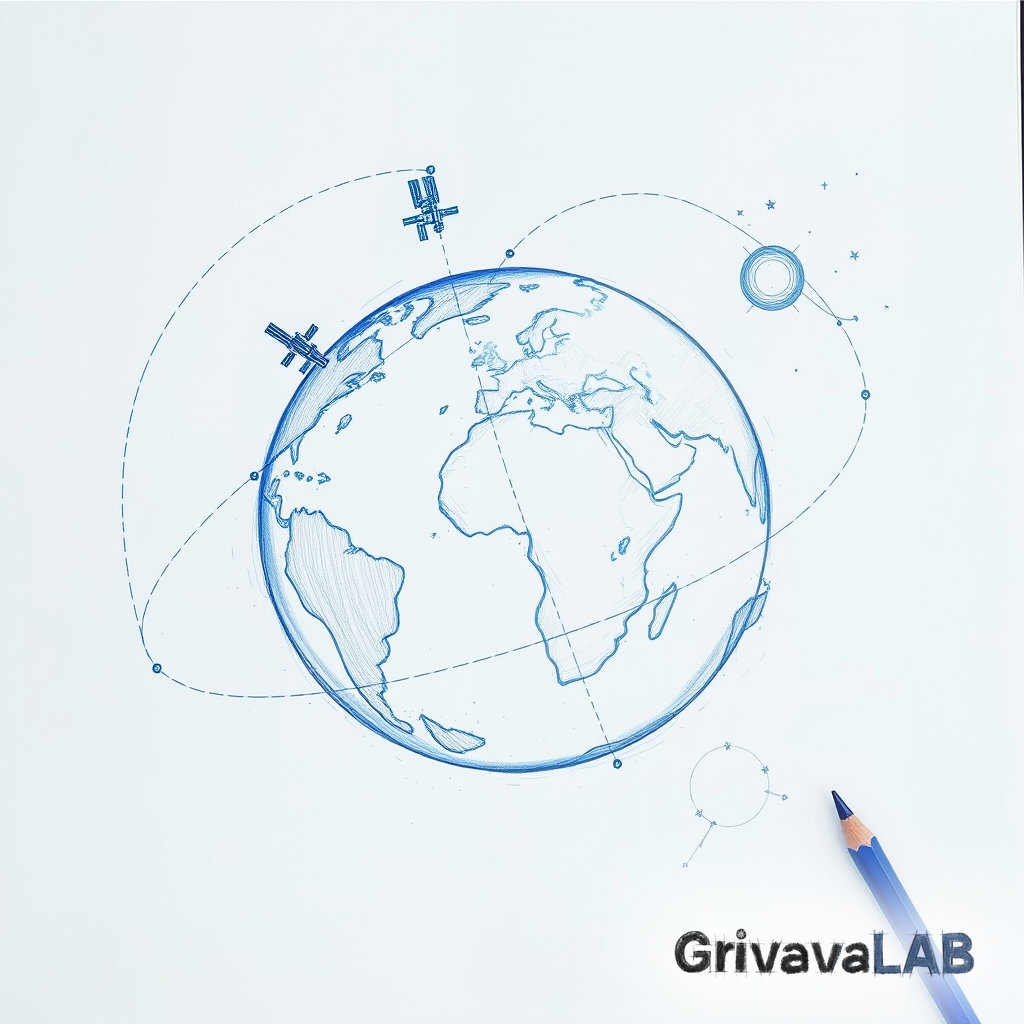
For the past months GrivavaLAB has asked a narrow, testable question: does space weather — solar activity, geomagnetic disturbance, cosmic-ray flux — leave a measurable fingerprint on human physiology, mood and behaviour? We built the pipelines, pulled decades of open data, and ran the analysis honestly, with lagged cross-correlation, multiple-comparison control and a full robustness battery.
This post is where we state, plainly, what we have found — and where the project goes next.
What we found
We do not find a credible direct link between space weather and human affairs. Across our studies — cortisol trends, behavioural proxies, domestic incidents, and more — initial signals consistently failed robustness testing: they dissolved under detrending, collapsed into Simpson's paradox, or vanished once we corrected for the sheer number of comparisons. Where a correlation survived at all, it was weak and offered no basis for prediction.
Let us be blunt about what this means. This is not astrology, and our data does not support astrology. The idea that a geomagnetic index governs your mood, your decisions, or the fate of nations does not hold up. On the evidence, the human being is a separate agent — acting, choosing and colliding with other humans for reasons that are overwhelmingly terrestrial, not cosmic.
A null result is still a result. In a field crowded with confident claims, an honest "we looked carefully, and the link is not there" is worth publishing as loudly as any discovery.
The one distinction that matters
There is a line that must not be blurred. Space weather is physically real and it does act on the world — but on machines and physics, not on human will:
- It perturbs satellites, GPS/GNSS accuracy, HF radio, power grids, polar aviation and the radiation dose of astronauts.
- These effects are measured, operational, and genuinely forecastable hours to days ahead.
So our position is precise: the Sun drives technology and physics; it does not drive people. We intend to prove both halves of that sentence with data — the presence of the first link and the absence of the second.
Where we're going: an honest observatory
That narrow question has grown into a larger purpose. GrivavaLAB is becoming a continuous, honest observatory of the whole situation — Earth and near-space. The instrument runs quietly, around the clock: it reads the world's news across many languages, it reads the markets, it reads the space-weather conditions overhead — and it makes a sober, agenda-free assessment of what is happening, on the planet and above it.
Three commitments define the work:
- Observe. Record the state of the world continuously, as a timestamped ledger — human events on one side, the physical state of near-space on the other.
- Assess. Judge it without an agenda. Report the signal, and report the absence of signal with equal clarity.
- Chronicle. Preserve the record openly and immutably, so that anyone later — a researcher, a reader, a future intelligence — can read an unmanipulated account of this era, and reuse the method.
We are not in the business of prophecy. Where physics allows it — in near-space — we will forecast honestly. Where it does not — in human affairs — we will not pretend to; we will instead do something useful and modest: detect anomalies and track trends, so the situation can at least be seen clearly. You cannot navigate a game whose board you cannot read. This project is an attempt to read the board.
What comes next
Starting now, we publish a daily brief: a concise, dated assessment of the world's day and the space weather above it. Each one is a small entry in a growing chronicle. Individually they help a reader take stock; together, over months and years, they become the time series against which the Sun–Earth question can keep being tested — fairly, in the open, by us and by anyone who cares to check.
The honest answer so far is that the cosmos and the human story run on separate tracks. We will keep watching both — and we will keep telling the truth about what we see.
All data from public, open-access sources. Methods are documented and reproducible. Correlation ≠ causation; we test, we do not prove.